Take Back the Sky

Because America STILL needs a private crewed US spaceship named SERENITY!

  • About Take Back the Sky
  • About Firefly and Serenity
  • Downloads

SpaceX Plans Es’hail-2 Launch for November 15

Posted by Chris Tobias on November 13, 2018
Posted in: Launches. Tagged: Cape Canaveral, Es'hail-2, Es'hailSat, Falcon 9, Kennedy Space Center, LC-39A, Of Course I Still Love You, SpaceX, Telstar 19 VANTAGE. Leave a comment

by Chris Tobias

SpaceX’s next launch is slated for Thursday, November 15 at 3:46 PM EST from Launch Complex 39A (LC-39A) at Kennedy Space Center at Cape Canaveral, Florida, when a Falcon 9 will send the Es’hail-2 communications satellite into geostationary orbit.

eshail-2-geostationary-satellite

Es’hail-2 will boost ham radio signals worldwide. (image: amsat-uk.org)

According to the Kennedy Space Center website, the satellite is designed to assist with broadband connectivity and broadcast capability for Qatar and its neighbors, but it will also boost the signal of ham radio operators from Brazil to Thailand.  The satellite is owned by Qatar’s national satellite communications company, Es’hailSat, but was built in Japan by Mitsubishi Electric Corporation.

Thursday’s launch, SpaceX’s 18th of the year, will be the 63rd flight of a Falcon 9 rocket to date.  The Falcon 9 that will launch Es’hail-2  is a previously-flown booster that was last used for the July 22 launch of the Telstar 19 VANTAGE communications satellite.

SpaceX is expected to attempt to recover the first stage of the Falcon 9 aboard the drone ship Of Course I Still Love You a few hundred miles off the Florida coast in the Atlantic Ocean.

The Es’hail-2 mission will also be the first time in several months that SpaceX has launched a Falcon 9 during the day, so those on the East Coast who want to view the launch won’t have to stay up late to do it this time around.  A live webcast of the launch should begin approximately 20 minutes before liftoff at spacex.com and on the company’s YouTube channel.

Peace, love and rockets…

NASA SOCIAL: ICON Part II

Posted by Chris Tobias on November 8, 2018
Posted in: Articles, Launches, Press Coverage. Tagged: @NASASOCIAL, Blue Origin, Cape Canaveral, Falcon 9, ICON, Kennedy Space Center, L-1011 Stargazer, NASA, NASA SOCIAL, Pegasus XL, SpaceX. Leave a comment

This is the second half of Jeff Cunningham’s two-part coverage of the NASA SOCIAL press event for the ICON atmospheric probe. As a disclosure, Jeff is employed by the Lockheed-Martin corporation, the original makers of the L-1011 Stargazer aircraft now operated by Northrop-Grumman mentioned in this article, though his employment is completely unrelated to said craft.

icon-in-orbit

After the unexpectedly cathartic visit to the Vehicle Assembly Building (VAB) and a lunch break, we were shuttled to the NASA press facilities overlooking the launch complexes.

img_20181024_125602
img_20181024_125649

Left: Approaching the NASA Press Briefing Room and television studio. Right: The view from the building of one of the former space shuttle launch pads.

img_20181024_130357
img_20181024_133140

We took our seats, and finally got down to business for the real reason we were here. We were addressed and were free to ask questions of:

  • Tim Dunn, Director of NASA’s Launch Services Program (left, in the blue shirt), who has the responsibility of selecting commercially available rockets like the Pegasus that are best suited to take given payloads into space.
  • Brian Baldwin, representing Northrop-Grumman, who briefed us on the current situation with the payload. Originally meant to launch from Kwajalein Atoll last year, the most recent delay that precluded us from seeing it go today was some “fishy” readings from the satellite’s own telemetry sensors collected during the ferry flight to Kennedy. It was decided to try again the next week after having another look at it (“working three separate issues, that’s all I can say,” he said) to make sure nothing was damaged in transit.

They also gave us an idea of the unique challenge involved with the launch. The Pegasus XL is a rocket that is actually dropped from high altitude by a heavily modified Lockheed L1011 (christened Stargazer) before igniting the engines and arching upwards towards space to deploy its payload in a lower orbit. In order for the launch to succeed, Stargazer’s crew must drop the vehicle in a “drop box” measuring only 10 by 40 km — a narrow window to hit at cruising speeds.

Once it makes it out into the Black, just what does ICON do? The Ionospheric Connection Explorer uses a series of instruments to study the interaction between Earth’s high-altitude weather systems and “space weather” phenomena in the ionosphere — which has a profound impact on the performance of satellites and spacecraft, and may well be the difference in just how many bars or “G’s” your smartphone’s network enjoys. After a one-week “shakedown” in orbit, it’ll start powering up sensors built by UT Dallas, UC Berkeley, and the US Naval Research Laboratory, calibrating itself using the light of three full moons. Following that, it’ll commence it’s two-year mission to advance our understanding of space weather.

After the briefing, our next stop, if you’ll believe it, was mission control — not the same one that’s used for crewed missions, mind you, but still the actual command and control stations used by NASA and partners for commercial launches, be it underslung Pegasus launches, or SpaceX Crew Resupply Services (CRS) launches aboard Falcon 9’s.

img_20181024_142852

In the lobby of the USAF hangar used for comms and telemetry for the launch and mission.

These particular control rooms are within the Cape Canaveral United States Air Force Base, where photography is restricted, though we were assured that we were in the clear for the interior of the building.

img_20181024_143015

Control room used by NASA management, VIPs and press

img_20181024_143030

Pictured: Workspace envy

img_20181024_151400
img_20181024_151752

Oddly enough, the control rooms used by the actual engineers, while lacking in decor, enjoy better workstations than management, with multiple curved-display monitors. “Just don’t tell our bosses,” said our guide.

img_20181024_153239

The Mission Director’s Center as it appeared in 1963

After that was the main event, when they bused us out to the “skid strip” to see Stargazer itself on the runway with ICON loaded in the Pegasus XL on the underside. Unfortunately, as it is a restricted Air Force Base, we weren’t allowed to take any photos, so I’m afraid all I can give you here is stock photos from Google as I try my best to describe the tour of the craft.

Pegasus XL CYGNSS Mate to L-1011

Stargazer with a Pegasus XL rocket mated to the underside in a prior mission

For a plane sitting on the runway, it had a lot of activity buzzing around it — though I suppose a live solid-fuel rocket isn’t something one can just set aside and neglect. Much like the photo above of a previous mission, air conditioning trucks and generators must continually pipe in a steady flow of cool nitrogen gas into the payload compartment of the Pegasus in order to maintain the original, clean-room sterility of the spacecraft.

The plane itself, the L-1011, is largely unknown to the public, because in its day, it lost out to its competitor, a modest aircraft you may have heard of called the 747. This particular one was purchased from a Canadian airline that was retiring it (“for less than a Tesla,” they kept saying, though they declined to comment on just which model they meant). There’re only a few remaining in the world, and even fewer pilots qualified to fly it — which may be why Stargazer’s part-time flight crew were some of the coolest customers I’d met at the Cape. Gregarious as your favorite uncle, and just as comfortable in their blue flight suits as Jimmy Buffett in a Hawaiian shirt.

The plane requires a crew of three, as it was one of the last modern airplanes to require a flight engineer instead of having a fully automated system as the 747 did (no doubt part of why one is still with us and the other nearly extinct). Each of the three men took groups of us through their ship, starting at the cockpit — where yours truly assumed the captain’s seat, because of course, and placed my hand on the Big Red Button because that’s what you do if you have a pulse.

Behind the flight cabin were the instrument stations where workers were performing maintenance on workstations that would monitor and relay the Pegasus’ telemetry among the few rows of remaining seats. Most of the seats, insulation, and even toilets were torn out of the craft during its modification to reduce its weight and free up greater capacity for the payload that was attached beneath our feet — it turns out that the L-1011 wasn’t selected just because it was cheap, but because it sports a very unique airframe structure unlike any other passenger jetliner, and was the only in existence that had a strong enough underside to carry a rocket.

After shaking hands and saying our goodbyes, it was time to get back on the bus and return to our cars and normal, boring lives. It gave me time to reflect as I watched the palm trees and occasional bald eagle nests pass by. After 2011, I’d grown accustomed to “the new normal,” and come to accept that NASA and the Cape may never know its former glory again, with the exception of a few bright, rising stars such as SpaceX and Blue Origin. I couldn’t be more happy to be proven wrong, and to have my “faith” in it all restored, if you will. Heck, it gets me thinking that there may yet be hope that I’ll get to live the dream and work out here someday.

Very, very special thanks to @NASASOCIAL for inviting us to this press event.

Take Back the Sky Meets an ICON

Posted by Chris Tobias on November 3, 2018
Posted in: Articles, Launches, Press Coverage. Tagged: @NASASOCIAL, Apollo 13, Cygnus, Firefly, ICON, International Space Station, Kennedy Space Center, NASA, NASA SOCIAL, Orbital/ATK, Pegasus XL, Scott Kelly, SLS, Space Shuttle Columbia, SpaceX, Star Wars. Leave a comment

icon-in-orbit

Take Back the Sky’s own Jeff Cunningham was recently invited to a NASA press event centered around the launch of the Ionospheric Connection Explorer (ICON) spacecraft aboard an air-launched Pegasus XL rocket. In this series of posts, he’ll share his behind-the-scenes tour of NASA’s latest and greatest projects going on at Kennedy Space Center in Florida. Continue Reading

SpaceX’s SAOCOM-1A Launch This Weekend Will Feature First RTLS Landing on the West Coast

Posted by Chris Tobias on October 6, 2018
Posted in: Launches. Tagged: Block 5, Cape Canaveral, CONAE, COSMO-SkyMed, Falcon 9, Iridium NEXT 7, Just Read the Instructions, SAOCOM-1A, SLC-4E, SpaceX, Vandenberg Air Force Base. Leave a comment

by Chris Tobias

SpaceX plans to launch the SAOCOM-1A satellite this weekend from Vandenberg Air Force Base in California, with liftoff currently scheduled for 10:21 PM EST (2:21 UTC) on Sunday, October 7 from Space Launch Complex 4E (SLC-4E).

This weekend’s launch will feature the same Falcon 9 Block 5 first stage that launched Iridium NEXT 7, and will be just the second time that a Block 5 Falcon 9 core has been reflown.  The payload, the SAOCOM-1A satellite, will be delivered to a Sun-Synchronous Orbit, where it will be part of a six-satellite constellation that CONAE (the Argentine space agency) will use to image the Earth in conjunction with the Italian COSMO-SkyMed satellite constellation.

23802553412_d79eefae9f_k

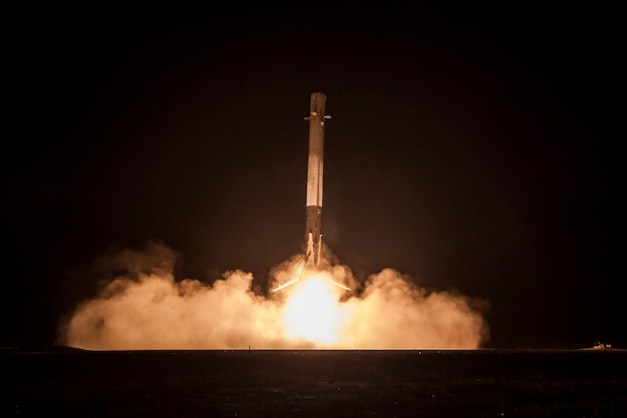
A Falcon 9 first stage comes in for a landing at Cape Canaveral Air Force Station in Florida.  (Photo:  Spaceflight Now)

What makes this launch particularly interesting is that the Falcon 9’s first stage will return to the launch site at Vandenberg AFB to land, which will make it the first RTLS (Return to Launch Site) landing on the West Coast.  All of SpaceX’s previous RTLS landings have been conducted at Cape Canaveral Air Force Station in Florida.  The Falcon 9 first stage that is being reflown for this mission previously landed at sea aboard SpaceX’s drone ship Just Read the Instructions during the Iridium NEXT 7 mission back in July.

A live webcast of the launch should be available at spacex.com and on the company’s YouTube channel approximately 20 minutes before liftoff.

Peace, love and rockets…

If a SpaceX Crew Dragon Named “Serenity” Has a Shot, Well It’s Probably Her

Posted by Chris Tobias on September 23, 2018
Posted in: Articles. Tagged: Amber Heard, Apollo 8, Battlestar Galactica, BFR, Browncoats, Commercial Crew Program, Crew Dragon, Elon Musk, Firefly, Grimes, Gwynne Shotwell, Joss Whedon, Malcolm Reynolds, Serenity, SolarCity, SpaceX, Tesla, The Boring Company, Tony Stark, Yusaka Maezawa. Leave a comment
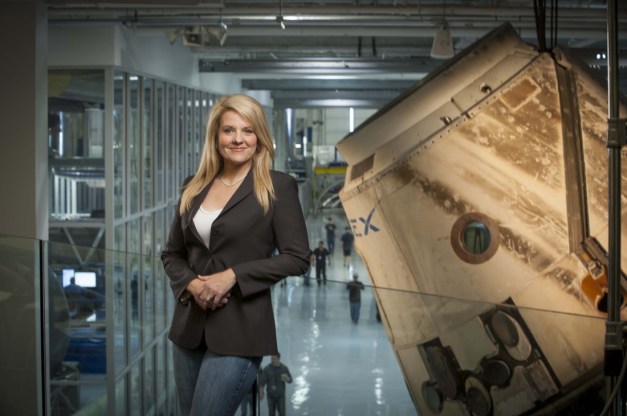
spacex-president-coo-gwynne-shotwell

SpaceX President and Chief Operating Officer Gwynne Shotwell has admitted in more than one interview that she and her employees are fans of “Firefly.” (Photo: Teslarati)

by Chris Tobias

In the six years that Take Back the Sky has been campaigning for a SpaceX Crew Dragon named Serenity, we’ve been encouraging people to send cards and letters to the company’s founder and CEO, Elon Musk, asking him to name the first ship of the line after the spaceship in Joss Whedon’s 2002 TV series Firefly.

From 2013-2016, Jeff and I appeared at numerous comics and science-fiction conventions across four states with the same message:  it’s Elon Musk’s ship, and Elon Musk’s money, so, ultimately, the decision as to what the name of the first Crew Dragon will be is going to be his.

While that may still be true, in recent months some developments have led us to believe that Elon Musk himself may no longer be the key player in whether or not our campaign is successful.  With less than a year to go until the Crew Dragon is launched for her first manned demo flight, we now believe that if we are to convince SpaceX to name the ship after Serenity, the person we really need to win over is President and Chief Operating Officer Gwynne Shotwell.  Here’s why…

Continue Reading

Falcon 9 in Prime Time: SpaceX to Launch Telstar 18V Sunday Night

Posted by Chris Tobias on September 8, 2018
Posted in: Launches. Tagged: APT Satellite Co. Ltd., Cape Canaveral, Falcon 9, Of Course I Still Love You, SLC-40, SpaceX, Telesat, Telstar 18V, USAF 45th Space Wing. Leave a comment

by Chris Tobias

It’s almost become a rarity to have a break between SpaceX launches anymore.  It seems like we’ve written a lot this summer about multiple launches in the span of a week, or even two launches in a weekend, so it’s kind of hard to believe that it’s been over a month since the last time a Falcon 9 broke atmo.  That will change Sunday night though, when SpaceX launches the Telstar 18 Vantage satellite (Telstar 18V for short) into Geostationary Transfer Orbit from Space Launch Complex 40 (SLC-40) at Cape Canaveral Air Force Station in Florida.

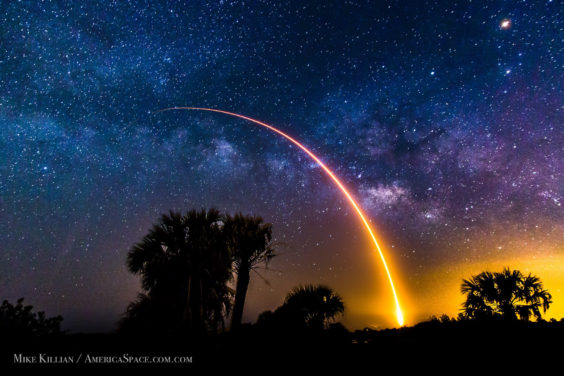
Mike-Killian-AmericaSpace-full-2-564x376

Night launches of the Falcon 9, like the one SpaceX plans this Sunday, can be visually quite spectacular. (Photo: Mike Killian via Space Coast Daily)

The upcoming launch, which is scheduled for September 9 at 11:28 PM EDT (03:28 UTC), will feature a brand new “Block 5” Falcon 9 that has never previously flown.  SpaceX plans to recover the rocket’s first stage in the Atlantic Ocean aboard the drone ship Of Course I Still Love You.

The Telstar 18V is a communications satellite that will be shared between the Canadian company Telesat and Hong Kong’s APT Satellite Co. Ltd.  According to Telesat, it is designed to aid communications from India and Pakistan all the way to Hawaii, and has a potential mission length of more than 15 years.  SpaceX successfully launched the second satellite in this series in July of this year.

The most recent weather forecast from the U.S. Air Force 45th Space Wing shows 60% favorable conditions for Sunday night’s launch.

So, if you’re looking for an alternative to ESPN’s Sunday Night Baseball (Astros at Red Sox, if you were wondering) or NBC’s Sunday Night Football (Bears at Packers, if you care), you can watch the prime time launch of Telstar 18V live online at spacex.com or the company’s YouTube channel.  For those new fans out there, SpaceX typically begins its live webcast of launches approximately 20 minutes before liftoff.

Peace, love and rockets…

Penny for My Thoughts: Speculation on Commercial Crew Assignments

Posted by Chris Tobias on August 20, 2018
Posted in: Articles, Launches. Tagged: Astronaut Corps, Atlantis, Bob Behnken, Boeing, Browncoats, Chris Ferguson, Chuck Yeager, Commercial Crew, Crew Dragon, Doug Hurley, Eric Boe, International Space Station, Josh Cassada, Michael Hopkins, NASA, Nicole Mann, Serenity, Space Shuttle, SpaceX, Starliner, Sunita Williams, Victor Glover. 1 Comment
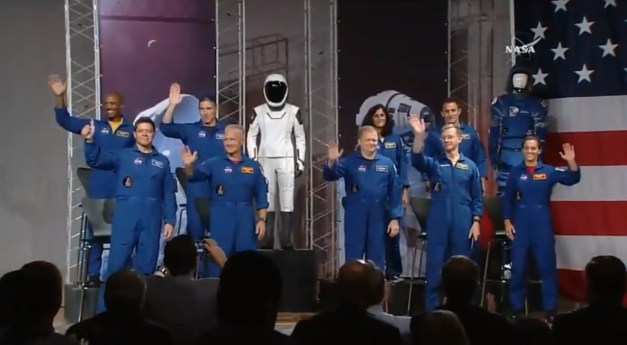
nasa-announces-commercial-crew-astronauts

Credit: Space.com

by Jeff Cunningham

Ni-hao, y’all — Jeff here, Rocket-Scientist-in-Residence here at Take Back the Sky. I’ve been offline for some time now tending to a newly arrived future Browncoat. Last week, NASA finally announced the assignments of which astronauts will be assigned to which flights aboard which independently made American spacecraft. I’m rather surprised that no one is commenting on what’s right there in the open for everyone to see, so I thought I’d offer my two cents here. Continue Reading

Browncoat Ball Offers a Unique Opportunity for Fans to Celebrate Their Love of Firefly and Serenity

Posted by Chris Tobias on August 12, 2018
Posted in: Articles, Con Presence. Tagged: Battle of Gettysburg, Browncoat Ball, Browncoats, Can't Stop the Serenity, Civil War, Crew Dragon, Delaware Valley Brigade, Elon Musk, Firefly, Gettysburg, Gettysburg Historic Battlefield, Gettysburg National Military Park, Gwynne Shotwell, Inara Serra, Joss Whedon, Malcolm Reynolds, Michael Shaara, River Tam, Rivers & Bridges Brigade, Rush, Sean Faust, Serenity, Serenity Valley, Shawna Trpcic, Smash the Windows, SpaceX, Summer Glau, The Hero of Canton, The Killer Angels, Zoe Washburne. 1 Comment

by Chris Tobias

In 2004, the Chicagoland Browncoats decided to hold a one-night banquet that was planned as a formal Sino-Western ball like the one in the Firefly episode “Shindig.”  The event was such a hit that Browncoats decided not only that they would do it annually, but also that they would host it in a different city every year.  This unique shindig, officially dubbed the “Browncoat Ball,” has moved from location to location, year after year, and has gradually evolved into a full weekend of social activities, sightseeing at local tourist attractions and celebrating all aspects of the Firefly and Serenity ‘verse.

Great-Seal-of-the-Browncoat-Ball-2018

Previous Browncoat Balls have been held in Chicago, San Francisco, Philadelphia, Austin, Portland, Charlotte, Warwick (RI), Albuquerque, Phoenix, Greenville (SC), Virginia Beach, Salt Lake City, and most recently Gettysburg, PA.  This year’s Browncoat Ball will be held August 17-19 in Washington, DC.

I attended my first (but hopefully not only) Browncoat Ball last year, and after my weekend at the Gettysburg shindig, I am convinced that every serious fan of Firefly and Serenity should make it a point to attend this event at least once.  While every ball is different, I hope that the following account of my time at last year’s ball might give you some idea of what to expect if you decide to go.

Continue Reading

For SpaceX, Early August Will Have Its Ups and Downs– Literally

Posted by Chris Tobias on August 2, 2018
Posted in: Launches, Updates. Tagged: Bangabandhu-1, Cape Canaveral, CRS-15, Dragon, Elon Musk, Falcon 9, International Space Station, Johnson Space Center, Merah Putih, Of Course I Still Love You, SLC-40, SpaceX, Telkom-4. Leave a comment

by Chris Tobias

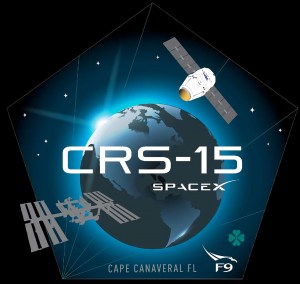
It’s been a busy summer for SpaceX, and this month will be no exception.  One might say the beginning of August will have its ups and downs for Elon Musk and company– quite literally– with the CRS-15 mission drawing to a close and the launch of yet another satellite.

dragon_spx-15_spacex

Image:  spacefacts.de

SpaceX’s Dragon will return to Earth this weekend after spending more than a month berthed at the International Space Station, signaling the end of the CRS-15 mission.  The capsule is scheduled for splashdown south of the Port of Los Angeles on Friday, August 3.  Should an alternative landing date be deemed necessary, Dragon’s return could be postponed until Sunday, August 5, with splashdown occuring in the same general area.  Once recovered, Dragon will be brought back to the Port of Los Angeles for the unloading of any time-sensitive cargo.  The remainder of Dragon’s cargo will be unloaded once the capsule has arrived at Johnson Space Center in Houston, Texas.

And on Tuesday, August 7, SpaceX plans to launch a Falcon 9 from Space Launch Complex 40 (SLC-40) at Cape Canaveral Air Force Station in Florida.  Falcon will be carrying the Merah Putih (Telkom-4) communications satellite, which will provide coverage to Indonesia and India.  Liftoff is scheduled for 1:19am, EDT (5:19 UTC).  The Falcon 9 that will be used for this upcoming mission previously flew for the Bangabandhu-1 mission.  The Merah Putih satellite will be placed in a Geostationary Transfer Orbit, and the Falcon 9’s first stage will be recovered once again, with a landing planned in the Atlantic Ocean on SpaceX’s drone ship Of Course I Still Love You.

Those who would like to watch the launch can tune in to spacex.com or the company’s YouTube channel.  SpaceX’s webcasts typically begin around 20 minutes before liftoff.

Peace, love and rockets…

Farewell, #FollowFriday

Posted by Chris Tobias on August 2, 2018
Posted in: Updates. Tagged: Browncoats, Commercial Crew, Crew Dragon, Dragon, Elon Musk, Firefly, Follow Friday, NASA, Serenity, SpaceX. Leave a comment
Follow Friday

Image:  Twitter

by Chris Tobias

For nearly six years now, our Twitter account (@TakeBacktheSky) has been participating in that Twitter tradition known as “Follow Friday.”  It’s really not clear to us where the practice originated, but the idea of recommending accounts that others should follow (and perhaps having others recommend yours) was one that seemed like a valuable tool back when we first started Take Back the Sky.  After all, the more times a Twitter handle shows up in the Twitterverse, the more likely folk will be to check out who’s behind it and what they’re all about.  In the early days of our campaign, it’s likely that Follow Friday tweets actually did give us some valuable exposure, especially when we still had active online petitions asking Elon Musk and SpaceX to name their first Crew Dragon after Serenity.

But after careful consideration, we believe the time has come for us to end our participation in Follow Friday.

Continue Reading

Posts navigation

← Older Entries
Newer Entries →
  • Like us on Facebook

    Like us on Facebook
  • Follow us on Twitter

    My Tweets
  • Enter your email address to join the fight and receive updates from us by email!

    Join 77 other subscribers
  • Categories

    • Ad Astra Per Aspera
    • Articles
    • Astronaut Profiles
    • Con Presence
    • Good Works
    • Launches
    • Press Coverage
    • Reviews
    • Science of Firefly
    • Tributes
    • Uncategorized
    • Updates
    • World Space Week
  • Archives

  • Search

Blog at WordPress.com.
Take Back the Sky
Create a free website or blog at WordPress.com.
Privacy & Cookies: This site uses cookies. By continuing to use this website, you agree to their use.
To find out more, including how to control cookies, see here: Cookie Policy
  • Subscribe Subscribed
    • Take Back the Sky
    • Join 77 other subscribers
    • Already have a WordPress.com account? Log in now.
    • Take Back the Sky
    • Subscribe Subscribed
    • Sign up
    • Log in
    • Report this content
    • View site in Reader
    • Manage subscriptions
    • Collapse this bar
 

Loading Comments...
 

You must be logged in to post a comment.