Courtesy SpaceX Updates via Twitter
by Chris Tobias
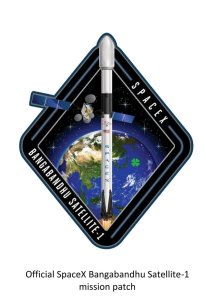
On May 10, SpaceX is scheduled to launch the Bangabandhu-1 satellite to geostationary transfer orbit from Launch Complex 39-A (LC-39A) at Kennedy Space Center, Cape Canaveral, Florida.
Bangabandhu-1 will be Bangladesh’s first geostationary communications satellite. Its name means “friend of Bengal,” and it is named in honor of the founding father of the nation of Bangladesh. It is designed to provide communications services to Bangladesh and surrounding countries for at least the next 15 years.
The Falcon 9 that will carry Bangabandhu-1 into the black is scheduled to liftoff at 16:12 EST (20:12 UTC) on Thursday. The mission will also feature a landing of the Falcon 9’s first stage at sea aboard the SpaceX drone barge Of Course I Still Love You.
The highlight of the mission, however, will be the debut of the new “Block 5” variant of the Falcon 9. The Block 5 features a number of design upgrades that are intended to improve the rocket’s efficiency and safety, while allowing SpaceX to refly each first stage booster as many as ten times or more. (None of the previous Falcon 9 boosters have broken atmo more than twice.)

SpaceX founder and CEO Elon Musk released this photo of the rollout of the Block 5 variant of the Falcon 9, which will launch on May 10.
SpaceX has indicated that the Block 5 will be the final variant of their workhorse Falcon 9. The company will now concentrate on the development of its BFR, or “Big Falcon Rocket,” as well as the production of the Falcon Heavy (the rocket that we hope will soon carry US astronauts to the International Space Station aboard a Crew Dragon named Serenity), while its Block 5 fleet of Falcon 9 rockets handles SpaceX’s ambitious manifest of scheduled commercial satellite launches.
Those who want to see the new Falcon 9 Block 5 in action can watch Thursday’s launch online. As is usually the case, SpaceX’s live coverage of the launch will begin on spacex.com and the company’s YouTube channel approximately 20 minutes prior to liftoff.
Peace, love and rockets…

(Image: Sending a Wave)
by Chris Tobias
On March 31, the UK Firefly and Serenity podcast Sending a Wave announced that it was coming to an end after twelve years of keeping Browncoats around the world up-to-date on all the latest conjurings in the Firefly fandom throughout the ‘verse. Sending a Wave will always be very special to all of us here at Take Back the Sky, because the podcast was the first media outlet to interview Jeff and me (way back in the 2012) about our efforts to convince Elon Musk and SpaceX to name their first Crew Dragon Serenity. Not only did our interview on Sending a Wave spread the news of what we were doing to a worldwide audience, it also gave our campaign a level of legitimacy in the Browncoat community that it hadn’t had previously. This was especially crucial to the success of our first online petition to SpaceX, which ended up with thousands of signatures from every continent except Antarctica, accompanied by comments in multiple languages.
About a year later we had the pleasure of meeting Wendy Scott, co-creator and host of Sending a Wave, in person at Wizard World Philadelphia Comic Con in June of 2013. At the con that weekend, Wendy interviewed me again about my work as the event coordinator of Pittsburgh’s Can’t Stop the Serenity charity screenings, and together we attended the Firefly panel that featured Adam Baldwin, Summer Glau, Jewel Staite and Gina Torres. Wendy is a lovely woman who is tremendously knowledgeable about science-fiction and the film industry and an absolutely fascinating person to talk to. One of my favorite things about Wendy, both as a podcast host and as a friend, is that her “BS-meter” is finely-tuned, and she’s not afraid to call anyone out if their story has the odor of a fabrication or a retcon. (If you don’t believe me, you can hear her give me a much-needed history lesson upon our first meeting in Sending a Wave Episode 93: The One with Dragons!)
When I heard about the end of Sending a Wave, I contacted Wendy to ask her if it would be okay if I achieved some closure of sorts by bringing things full circle and interviewing her about what had been great run of a groundbreaking Firefly and Serenity podcast. She graciously agreed, and on April 28 we spent nearly three hours on Skype talking about everything from the podcast itself to geek culture, science-fiction of all kinds, Joss Whedon, CSTS, the current state of the film industry and even American and European politics. As you can guess, that conversation meandered in many different directions. The following is a transcript of questions Wendy answered that were specific to Sending a Wave:

Matt Ryan as John Constantine (Photo: CW Seed)
by Chris Tobias
Back in 2014, one of my favorite characters from DC Comics, John Constantine, was given his own television series on NBC. The series, which was simply called Constantine, starred Welsh actor Matt Ryan in the title role and used many of the classic stories from the original Hellblazer comics that were published by DC’s subsidiary comics imprint Vertigo. Despite strong stories and a very good cast, NBC never quite figured out how to promote Constantine properly, and it was cancelled after just one 13-episode season due to poor ratings in its Friday night time slot, much to the disappointment of a small but loyal fan base.
Does any of this sound familiar?
by Chris Tobias
SpaceX makes history at breakneck speed. In just a few hours, Elon Musk and company will launch their 50th Falcon 9 rocket!
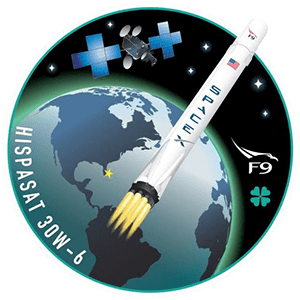
Hispasat 30W-6 mission patch (via spacexnow.com)
Although it’s become the norm for SpaceX to refly its Falcon 9 boosters, it is actually a brand new Falcon 9 that will carry the Hispasat 30W-6 satellite to a Geostationary Transfer Orbit (GTO). The milestone launch is scheduled for the early morning of Tuesday, March 6 from Space Launch Complex 40 (SLC-40) at Cape Canaveral Air Force Station in Florida. The two-hour launch window opens at 12:33 am EST, or 5:33 UTC. (If necessary, a two-hour back-up launch window is available at the same times on Wednesday, March 7.) The Hispasat 30W-6 satellite, which is designed to provide television, broadband, corporate networks and other telecommunications, will be deployed approximately 33 minutes after launch.
It appears that one of the trickier aspects of SpaceX’s launch-recover-relaunch operations might be the effect that launch delays can have on the ability to recover boosters. This particular launch was scheduled for late February, but was delayed because additional testing was needed on the fairing’s pressurization system. Back in February, the plan was to recover this brand new Falcon 9 booster aboard SpaceX’s drone ship Of Course I Still Love You, and the company had even debuted its brand new “spider boat” Mr. Steven, which has been specially designed to catch fairings. But the SpaceX recovery fleet was called back to port over the weekend, and the official press kit for this mission confirmed that SpaceX will not attempt to land the Falcon 9’s first stage after launch due to rough seas in the recovery area off Florida’s Atlantic Coast. It’s probably a good bet that SpaceX would have preferred to recover this shiny new booster to fly it another day, but Badger’s assessment of crime and politics in the pilot episode of Firefly applies to the business of launching rockets as well: “The situation is always… fluid.”
Speaking of fluid, if you’re on the East Coast, you might want to put on a pot of coffee if you plan on staying up to see the 50th Falcon 9 break atmo, but for those who want to watch the launch live online, SpaceX’s webcast of the mission will go live approximately fifteen minutes prior to liftoff at spacex.com.
Peace, love and rockets…
by Chris Tobias
There is a sports car in deep space. Everyone with a smart phone knows what the Falcon Heavy is. It’s official: SpaceX has made launching rockets sexy.
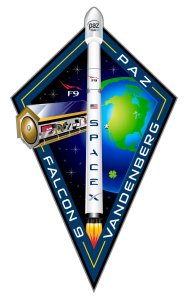
But while the public recovers from its “Falcon Heavy hangover,” SpaceX is already focused on the next mission. And that mission is the launch of the PAZ satellite to Low Earth Orbit aboard a Falcon 9 this Wednesday morning, February 21 from Space Launch Complex 4E (SLC-4E) at Vandenberg Air Force Base in California.

PAZ Mission Patch (SpaceX)
The Falcon 9’s first stage that is being used for the PAZ mission previously flew for the FORMOSAT-5 mission from SLC-4E in August of 2017. SpaceX will not attempt to recover the Falcon 9’s first stage after launch, which is almost becoming standard operating procedure for launches involving the older model of their previously-flown boosters.
The PAZ satellite was to have been launched this past Sunday, but SpaceX’s team at Vandenberg wanted to take some additional time to perform final checkouts of the upgraded fairing, which necessitated a postponement to February 21 due to mission requirements. It is perhaps a testament to just how much SpaceX has raised public awareness of the private space industry that the initial delay of this West Coast rocket launch actually made the local news broadcasts in this writer’s hometown of Pittsburgh, PA!
Tomorrow’s PAZ mission is scheduled for liftoff at 9:17am EST (14:17 UTC). For those who’d like to enjoy a rocket launch with their eggs and coffee, SpaceX’s live webcast should begin approximately 20 minutes before liftoff on the company’s website and YouTube channel.
And don’t forget, there has never been a better time to write SpaceX Founder and CEO Elon Musk and/or President and COO Gwynne Shotwell to congratulate them on their recent success and ask them to consider the name Serenity for the company’s first Crew Dragon. If you’re not sure what else to write, just tell them we Browncoats think Serenity is the perfect name for a space capsule that will become the flagship of a company that makes doing the impossible look routine!
Peace, love and rockets…

Elon Musk’s personal Tesla Roadster loaded inside the spacious Falcon Heavy payload fairing, which will throw it into a Martian Transfer Orbit during this week’s demonstration launch.
by Jeff Cunningham
On Tuesday, February 6th, during a launch window that opens at 1:30 PM and ends at 4:30 PM EST, SpaceX will attempt the maiden launch of its newest launch vehicle, the Falcon Heavy. As a demonstration flight, rather than a commercial or government satellite, it will instead launch a test payload consisting of CEO Elon Musk’s own Tesla electric roadster.
The historic significance of this launch will be lost on most, dismissed by cynics as just another corporation debuting a new product they hope to court the masses with. What a majority of people fail to realize is that not all rockets are created equal.

Image: SpaceXNow
by Chris Tobias
Now that Elon Musk has officially announced a target launch date of February 6, it’s hard not to be excited about SpaceX’s upcoming maiden launch of the Falcon Heavy. Before that happens though, there is the not-so-small matter of another launch of a (literally) tried-and-true Falcon 9 this week.
This Tuesday, January 30, SpaceX is scheduled to launch the GovSat-1 (SES-16) satellite into the black from Space Launch Complex 40 (SLC-40) at Cape Canaveral Air Force Station in Florida. If everything goes as planned, a previously-flown Falcon 9 will lift off Tuesday afternoon (or maybe evening, since there is a launch window of two hours and twenty-one minutes) and carry the multi-mission satellite into a Geostationary Transfer Orbit for LuxGovSat S.A. (a public-private joint venture between the government of Luxembourg and SES).
There will be no landing of the Falcon 9’s first stage during this launch, perhaps because SpaceX continues to phase out its older booster models in favor of newer ones.
The weather could definitely be a factor in this launch. At present weather forecasts only look about 40% favorable for a Tuesday launch, with high winds expected on that day. If the launch is delayed to Wednesday, January 31, conditions look to improve significantly. Current forecasts put the conditions at 90% GO on the back-up launch date.
The launch window for GovSat-1 is scheduled to open at 4:25pm EST (21:25 UTC) on Tuesday. As usual, live online coverage of this launch will be available on SpaceX’s website and on the company’s YouTube channel, with live streaming of the launch webcast beginning 20-30 minutes before liftoff.
Peace, love and rockets…

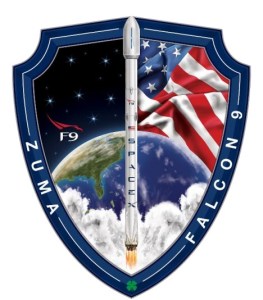
Zuma mission patch (Image: Ars Technica)
by Chris Tobias
After an impressive slate of achievements and historic firsts in 2017, SpaceX will kick off the new year with the launch of its still top-secret Zuma mission on January 5, 2018. The clandestine government payload, which was to have launched on board a Falcon 9 November 15 of last year, was delayed due to a payload fairing issue. That issue now appears to have been resolved, and a Falcon 9 is scheduled to take Zuma into the black this Friday, with a two-hour launch window opening at 8:00 PM EST. At this time the weather is 90% GO for launch from Cape Canaveral Air Force Station Space Launch Complex 40 (SLC-40) in Florida.
Not much more has been revealed about this mission or its payload since we first previewed it back in November of 2017. While it may seem unusual for anything that an Elon Musk-owned company does to have so little fanfare, it’s doubtful that we’ll have to get used to it.

Falcon Heavy vertical on the launch pad last month. (Photo: John Kraus)
SpaceX is set to have a spectacular 2018, starting with the planned maiden launch of the Falcon Heavy, which could happen as early as late January. The Falcon Heavy already caused quite a stir on social media when it briefly went vertical for fit checks at LC-39A at Kennedy Space Center at the end of last month, and Musk’s claim that its first payload would be his own Tesla Roadster has only added to the hype surrounding what will be the most powerful operational rocket in the world. We’ll be discussing the Falcon Heavy and its inaugural launch in more detail in the near future.
But the SpaceX milestone that we’re most anticipating in 2018 is the launch of the very first Crew Dragon, which will finally take US astronauts back out to the black from American soil for the first time in seven years. That launch should happen sometime late this summer or early in the fall, and when it does, we hope that the capsule will be named Serenity, after the Firefly-class transport ship in Joss Whedon’s TV series Firefly and its follow-up motion picture Serenity.
2018 marks our sixth year of lobbying SpaceX to name its first Crew Dragon Serenity, and if you’re a Browncoat (or if you just agree that it would be a good name), you can still help us bring our efforts to fruition. All you really need to do is write a brief letter to SpaceX founder and CEO Elon Musk, along with company president Gwynne Shotwell, urging them to christen SpaceX’s first manned spaceship with that name.
In the meantime, you should be able to watch a live webcast of the Zuma launch at spacex.com and on SpaceX’s YouTube channel on January 5. Coverage should begin approximately 20-30 minutes before liftoff.
On behalf of everyone here at Take Back the Sky, may your New Year be filled with peace, happiness, prosperity, and of course Serenity!
Peace, love and rockets…
by Chris Tobias
SpaceX plans to launch its thirteenth resupply mission to the International Space Station from Space Launch Complex 40 (SLC-40) at Cape Canaveral, Florida this Tuesday, December 12 at 11:46AM EST. A Falcon 9 rocket will carry an unmanned Dragon capsule into the black loaded with supplies, equipment and science experiments, including NASA’s Total and Spectral Solar Irradiance Sensor (TSIS-1) as well as a fiber optic payload. SpaceX will also attempt to recover the first stage of the Falcon 9 at the LZ-1 landing site at Cape Canaveral.
This is SpaceX’s first mission since indefinitely postponing the “Zuma” rocket launch that was to have taken place at LC-39A at Cape Canaveral last month. SpaceX indicated that it had some concerns stemming from a payload fairing test for another customer (the “Zuma” mission is supposed to launch a clandestine payload for an unnamed government agency), and that it was standing down until engineers completed their analysis. At this time that mission has yet to be rescheduled, but there are no such concerns for this launch.
According to SpaceX founder and CEO Elon Musk, Tuesday’s launch of the Dragon will also be the first time that both the orbital rocket and the capsule are being re-flown. SpaceX has successfully reused Falcon 9 boosters on multiple occasions, and has already sent a reused Dragon capsule to the ISS, but this will be the first mission for which both the rocket and the capsule are flight proven. SpaceX has made reusability a priority for several years now, both in an attempt to lower costs and in order to take a significant step toward the day when frequent, perhaps even daily, launches both to and beyond Low Earth Orbit are commonplace.
A crewed version of the Dragon space capsule is scheduled to make its first manned test flight in the latter half of the coming year as part of NASA’s Commercial Crew Program, and as you probably well know by now, it’s this Crew Dragon that we hope will be named Serenity after the Firefly-class transport ship in Joss Whedon’s cult-classic space western TV series Firefly and motion picture Serenity. (If you want to know how you can help us make that happen, visit our Take Action page.)
In the meantime, the unmanned, flight proven version of the Dragon will begin its journey to the ISS on Tuesday, and you can watch the mission unfold live online. SpaceX’s webcast of the launch will go live at spacex.com and on the company’s YouTube channel approximately 20-30 minutes prior to liftoff.
Peace, love and rockets.
You must be logged in to post a comment.